The 100 BTUs per 1 CFM Rule: Does It Apply to Residential Kitchens?
Deciding on the right ventilation power for your kitchen often leads homeowners to encounter the 100 BTUs per 1 CFM rule. This common guideline suggests that for every 100 BTUs of heat your stove produces, you need one cubic foot per minute of exhaust capacity. While this math seems straightforward, applying this industrial-style logic to a home kitchen is rarely the best approach.
Relying solely on this ratio can lead to oversized, noisy fans or, conversely, inadequate ventilation for modern cooking habits. Understanding whether this rule holds water requires looking at how residential kitchens actually function compared to commercial environments.
To answer the core question immediately: No, the 100 BTUs per 1 CFM rule is not a mandatory or even a particularly accurate standard for modern residential kitchens. It is a simplified heuristic often borrowed from commercial restaurant design, where high-volume, continuous cooking creates different thermal and particulate loads than home use.
Most residential range hoods are sized based on the width of the cooking surface and the type of fuel used, rather than a strict BTU-to-CFM calculation. Using this rule blindly often results in excessive airflow that triggers the need for expensive, complex makeup air systems.
The Origins of the Rule
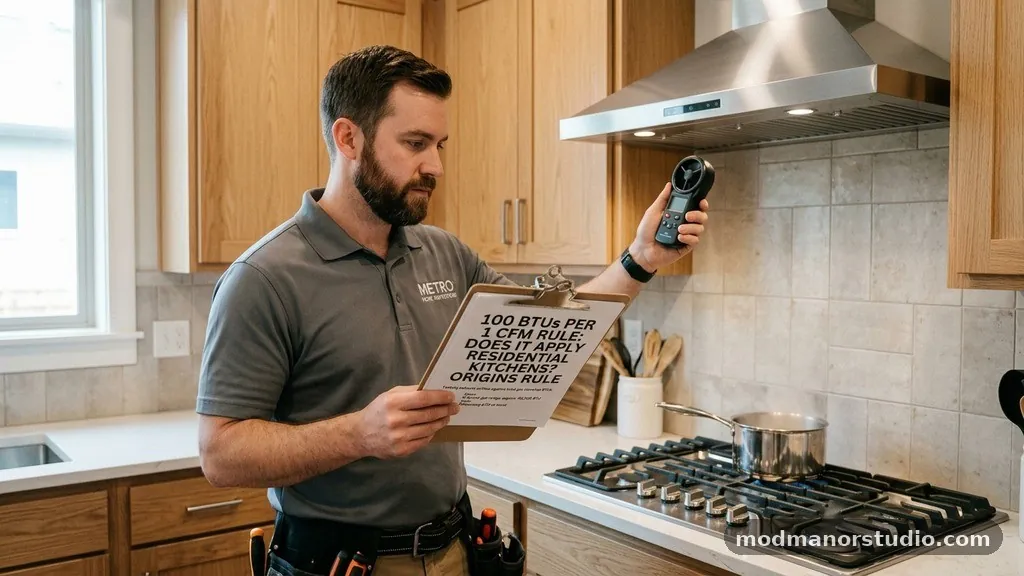
The concept of matching airflow to heat output has deep roots in the professional restaurant industry. In a commercial setting, massive ranges and ovens stay on for twelve hours or more, generating immense heat and grease.
Engineers developed the 100 BTUs per 1 CFM rule to ensure that commercial hoods could effectively capture the massive thermal plumes created by these heavy-duty appliances. This safety-first approach ensures that smoke, heat, and grease don’t linger in a space where staff are working at a high intensity for long periods.
Applying this same logic to a home kitchen ignores the fundamental differences in how we cook. A professional chef might sear steaks for four hours straight, but a home cook rarely operates all burners at maximum output for that duration.
Most home cooking sessions are intermittent, lasting only 20 to 60 minutes. Because the total heat load is much lower and the duration is shorter, a residential kitchen simply does not require the same brute-force extraction power as a professional line.
Why BTU-Based Sizing Often Fails
When you calculate CFM based purely on BTU output, you often end up with a fan that is far too powerful for your needs. For instance, a high-end gas range might put out 60,000 BTUs of total power.
Applying the rule would suggest you need a 600 CFM hood. While that sounds reasonable, many homeowners have ranges with even higher outputs, pushing the calculated requirement toward 1,000 CFM or more.
Installing a 1,000 CFM blower in a standard kitchen creates significant problems. These powerful fans require massive ducting to operate efficiently, often exceeding the standard 6-inch or 8-inch pipes found in most homes.
If you force that much air through a restrictive, undersized duct, the fan will become incredibly noisy and lose suction power. You essentially pay for performance that the home’s infrastructure cannot support.
The Importance of Makeup Air Systems

One of the biggest risks of over-venting a kitchen is the creation of negative pressure. When you run a powerful exhaust fan, it pushes air out of your house, which must be replaced by fresh air from outside.
In a modern, airtight home, that air has to come from somewhere, often pulling through gaps in doors, windows, or even down your water heater flue. This phenomenon is known as backdrafting, and it can be dangerous.
Building codes in many jurisdictions now mandate a makeup air system if your hood exceeds a certain threshold, usually around 400 CFM. This system brings in fresh, tempered air to balance the air being exhausted by your range hood.
If you follow the 100 BTUs per 1 CFM rule and install a massive fan, you are almost certainly triggering this requirement. This adds thousands of dollars to your renovation budget and requires complex mechanical integration.
Sizing Based on Width and Fuel Type
Instead of focusing on BTUs, industry professionals generally look at the width of the cooktop and the fuel source to determine the correct hood size. A standard 30-inch range typically works well with a hood that is at least the same width, though a 36-inch hood provides better capture area. The goal is to cover the entire cooking surface so that grease and steam don’t escape around the edges.
Fuel type is the other major factor in your planning. Gas ranges produce more combustion byproducts and heat than electric induction or radiant cooktops.
You generally need more ventilation for gas because you are dealing with both food particulate and carbon monoxide or nitrogen dioxide from the flame. Induction cooktops are much more efficient and produce significantly less heat, meaning you can often get away with a lower CFM rating.
Comparison of Ventilation Requirements
| Cooktop Type | Recommended CFM Range | Key Consideration |
|---|---|---|
| Electric Radiant | 300–400 CFM | Minimal heat and moisture |
| Electric Induction | 300–500 CFM | High efficiency, low ambient heat |
| Standard Gas Range | 400–600 CFM | Requires combustion byproduct removal |
| Professional Gas Range | 600–1200+ CFM | Needs makeup air and large ducts |
The Role of Capture Area
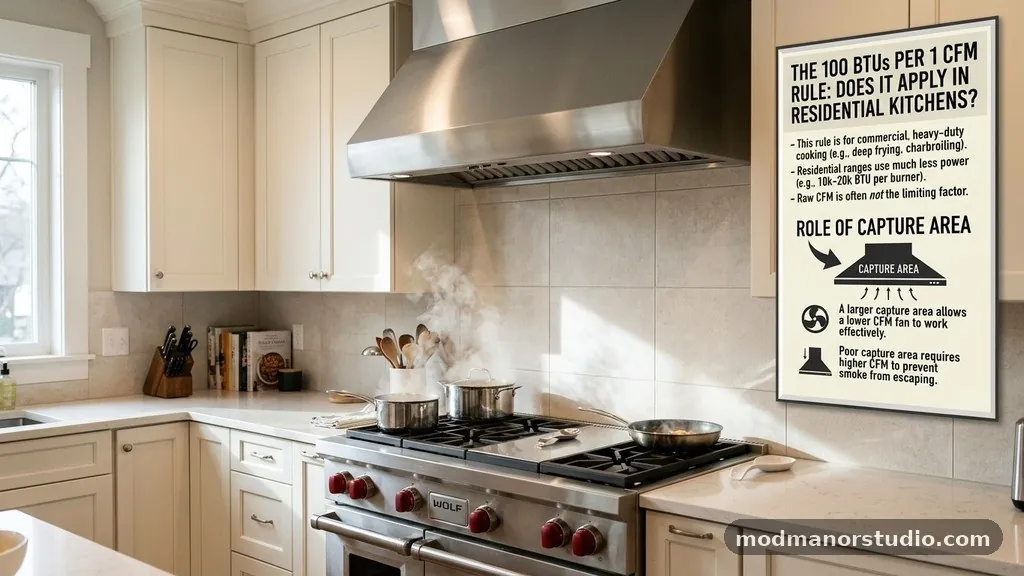
Capture area is arguably more important than the raw number of CFMs. This refers to the physical space under the hood that collects smoke and grease before the fan draws it into the ducting.
A deep, wide hood with a high-velocity fan will always perform better than a shallow, flat hood with a high CFM rating. If the smoke escapes the perimeter of your hood, no amount of suction power will bring it back.
Think of your hood like an umbrella. It needs to be large enough to catch the “rain” of smoke and steam rising from your pots and pans.
If your hood is too narrow, the plumes will simply drift up to your ceiling, leaving your walls and cabinets covered in grease. Prioritize a hood that extends at least 3 inches past the cooking surface on both sides if your kitchen layout allows it.
Ducting Constraints and Performance
Your ductwork is the silent partner in your ventilation system. Even the most expensive, high-CFM blower will struggle if it is connected to 4-inch flexible ducting.
Most manufacturers specify a minimum duct size, usually 6 or 8 inches, to ensure the fan can move air without excessive friction. Using “flex duct” or narrow pipes creates turbulence, which drastically reduces the actual airflow reaching the outside.
Smooth, rigid metal ducting is the gold standard for residential ventilation. Every turn or elbow in your ductwork also adds resistance, further reducing the performance of your range hood.
When planning your kitchen, try to keep the path to the exterior as short and straight as possible. If you must have turns, use long-radius elbows to keep the air moving smoothly.
The Impact of Noise Levels
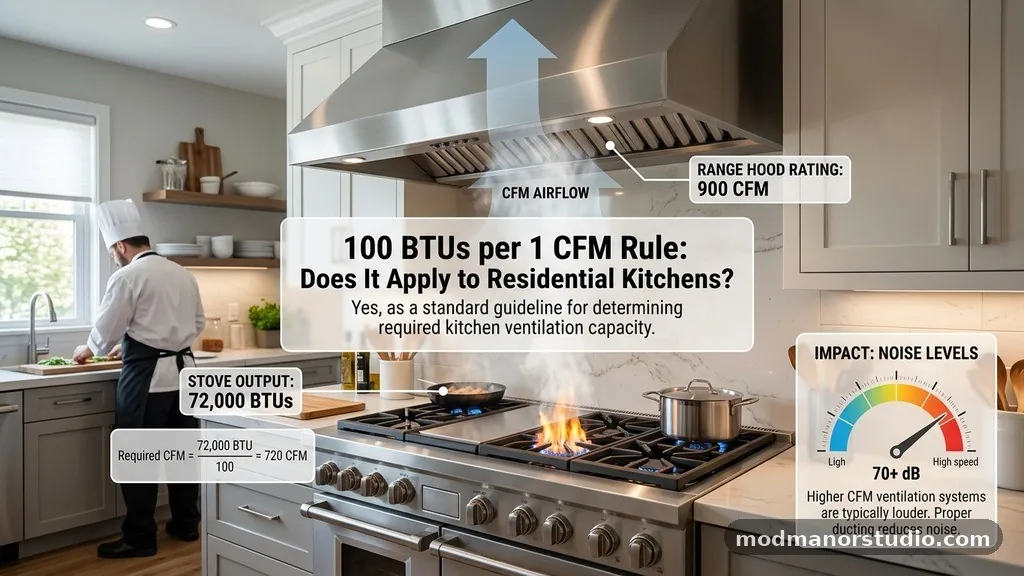
Noise is often the reason homeowners stop using their ventilation systems entirely. A 1,200 CFM fan running at full speed can be as loud as a vacuum cleaner, making it impossible to hold a conversation.
By over-sizing your fan based on the 100 BTUs per 1 CFM rule, you are essentially forcing yourself to live with a loud machine. Most people prefer a quieter fan that runs at a lower speed for a longer time over a loud one that clears the air instantly.
Modern hoods often feature variable speed settings, allowing you to match the power to the cooking task. You only need the maximum setting for heavy searing or frying.
For everyday tasks like boiling pasta or simmering sauce, a lower setting is usually sufficient. Choosing a high-quality motor with a reputable sound rating, measured in Sones, is a better investment than chasing higher CFM numbers.
Electric Induction vs. Gas
The rise of induction cooking has shifted the conversation about ventilation. Because induction technology heats the pan directly rather than the air around it, there is much less ambient heat in the kitchen.
This means the thermal plume is less aggressive, allowing for more modest ventilation requirements. Many homeowners are finding that they can achieve excellent indoor air quality with lower CFM ratings when switching to induction.
Gas ranges, by contrast, create a constant stream of hot, moist air. This requires a more robust system to handle the moisture and combustion byproducts effectively.
Even so, the average home kitchen does not need to replicate a restaurant environment. You are looking for a balance between air quality and the physical comfort of your cooking space.
Common Mistakes to Avoid
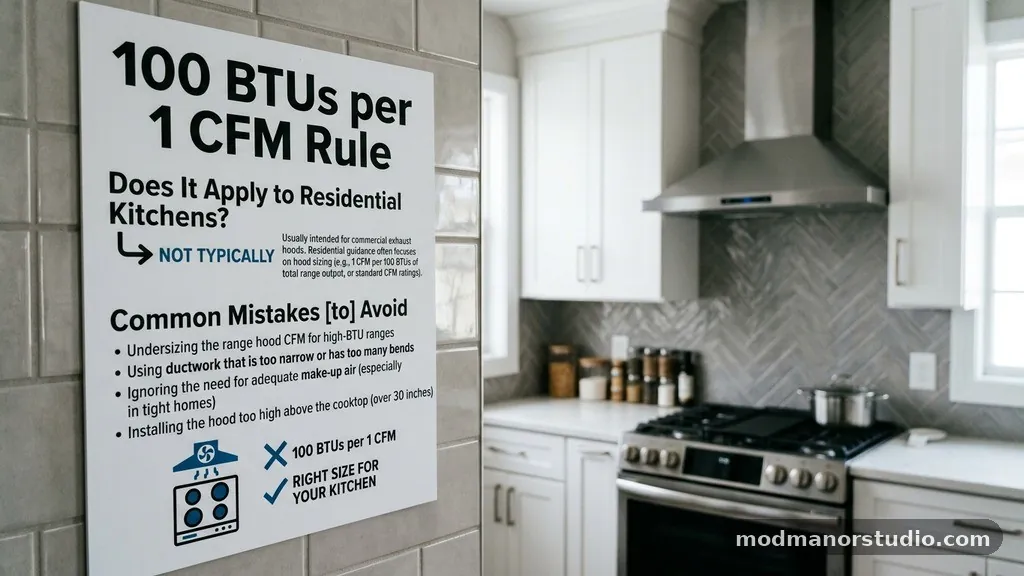
Many homeowners make the mistake of choosing a wall-mounted hood when their range is located on an island. Island hoods are notoriously difficult to vent because there are no walls to help guide the smoke into the collection area.
They require a significantly wider capture area and often a higher CFM rating just to compensate for the lack of containment. If you are planning an island cooktop, be prepared to invest in a premium ventilation solution.
Another common error is failing to turn the fan on before you start cooking. Ventilation works best when it creates a draft before the smoke and grease fill the room.
If you wait until the kitchen is already full of smoke, even a powerful fan will struggle to clear it quickly. The best practice is to turn the fan on low as soon as you turn on the burner.
- Turn the fan on 5 minutes before you start cooking to establish airflow.
- Clean your grease filters regularly to prevent airflow blockages.
- Ensure your exterior wall cap is not clogged with debris.
- Check that your ductwork is smooth, rigid, and correctly sized.
- Consider a hood with heat sensors that automatically adjust fan speed.
Consulting the Manufacturer Guidelines
Before you commit to a specific CFM rating, always look at the installation manual for your specific range. Manufacturers often provide clear recommendations on the type of ventilation required for their appliances.
They know the heat output and the specific needs of their equipment better than any generic rule of thumb. Following the manufacturer’s suggested minimums is the safest way to ensure your warranty remains valid and your kitchen remains comfortable.
You can also find useful information through resources like the Home Innovation Research Labs, which provides data on residential performance and building standards. These organizations focus on how homes actually perform, rather than applying commercial standards to residential spaces. They emphasize that proper installation and ductwork design are far more critical to success than simply buying the most powerful fan on the market.
Frequently Asked Questions
Does a 600 CFM hood always require makeup air?
The requirement for makeup air depends on your local building code. In many regions, the threshold is 400 CFM, meaning a 600 CFM hood would indeed mandate a makeup air system. Always check with your local building department before purchasing.
Can I use a larger duct to improve airflow?
Yes, using a larger duct than the manufacturer’s minimum can reduce static pressure and noise. However, it will not increase the fan’s maximum CFM capacity beyond its motor rating. It will simply help the fan operate more efficiently within its design parameters.
Is it better to have more CFM than I need?
Not necessarily. While having extra capacity allows you to run the fan on a lower, quieter setting, it also increases the likelihood of needing a makeup air system. A balanced system that meets your needs without unnecessary complexity is usually the best approach.
Why does my hood feel like it has no suction?
If your hood has power but lacks suction, the most common culprit is a blockage or restriction in the ductwork. Check the exterior vent cap for debris and ensure the ducting is not crushed or kinked. Also, ensure your grease filters are clean, as clogged filters severely restrict airflow.
Are island hoods less effective than wall hoods?
Yes, island hoods generally require more power and a larger capture area. Without a wall to catch and direct the rising smoke, air currents in the room can easily blow the smoke away from the hood. If possible, consider a wider hood than your cooktop to improve capture efficiency.
Final Thoughts
The 100 BTUs per 1 CFM rule is a relic of commercial design that rarely fits the needs of a modern home. While it provides a rough starting point for those who feel lost, it often leads to over-engineered systems that are noisy, expensive, and potentially hazardous due to negative pressure. Focus instead on the width of your cooktop, the type of fuel you use, and the quality of your ducting.
By prioritizing a proper capture area and smooth, well-sized exhaust paths, you can ensure your kitchen stays fresh and comfortable without breaking your budget. Always consult your appliance’s manual and local building codes as your primary guide for a safe, high-performing kitchen ventilation system.