How High Should a Range Hood Be Over an Electric or Induction Cooktop?
Deciding how high should a range hood be over an electric or induction cooktop is a critical step in your kitchen design process. Proper clearance ensures that your ventilation system captures steam, smoke, and odors effectively while preventing damage to the unit from excessive heat. If you mount it too low, you risk hitting your head or creating a fire hazard, but mounting it too high can render your fan powerless against rising grease.
This article provides the technical standards and practical advice you need to find the perfect height for your specific kitchen setup. You will learn the exact measurements required to keep your cooking environment safe, clean, and comfortable for every meal you prepare.
The Standard Height Range for Electric Cooktops
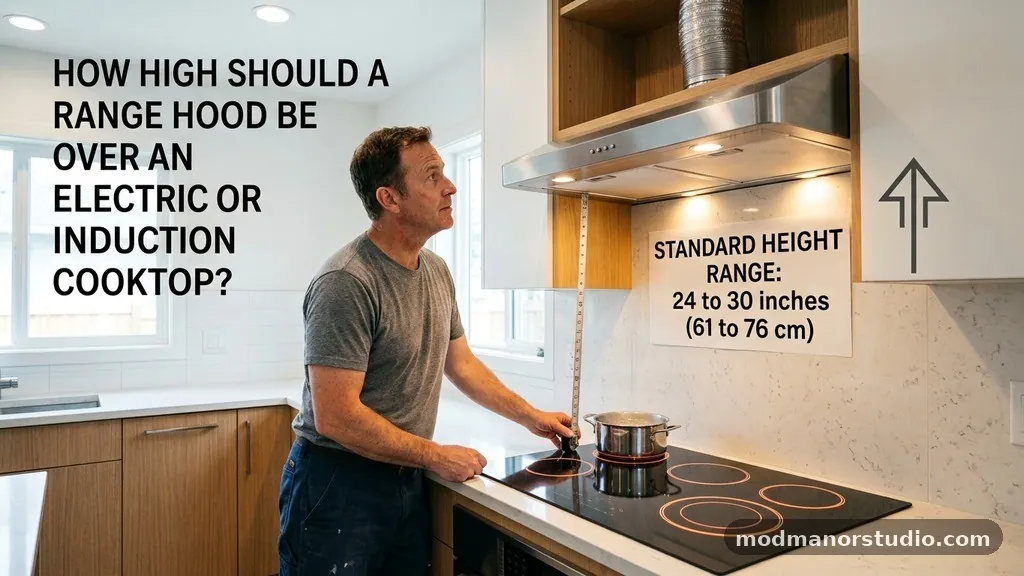
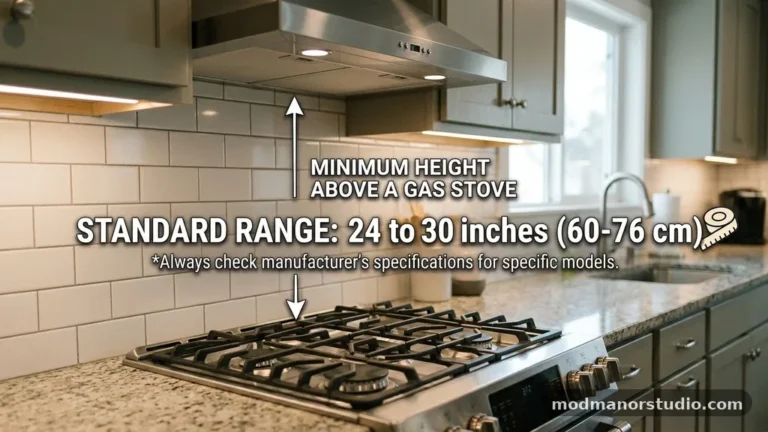
For most standard electric and induction cooktops, the manufacturer’s specifications are the final word. However, if you are looking for a general industry standard, most professionals recommend a clearance between 24 and 30 inches measured from the cooking surface to the bottom of the range hood.
This distance provides enough space for you to move pots and pans freely without bumping your head. It also keeps the intake close enough to the heat source to capture vapors before they dissipate into your kitchen air.
If you choose a height on the lower end of this spectrum, such as 24 inches, you will likely see an increase in capture efficiency. The hood acts as a vacuum that is closer to the source of the steam, making it highly effective at removing grease.
Yet, you must be careful with tall stockpots or boiling water. If your cookware is exceptionally tall, a 24-inch installation might make the workspace feel cramped or cluttered during intensive meal preparation.
On the other hand, mounting the unit at 30 inches offers a more open, airy feel in your kitchen. This height is often preferred for aesthetic reasons, especially if you have a large, decorative range hood that might look overwhelming if placed too close to the stove.
You should only opt for this higher range if your hood has sufficient CFM (cubic feet per minute) power. A weak fan mounted at 30 inches will struggle to pull air effectively, potentially leaving grease residue on your cabinets or ceiling over time.
Why Induction Cooktops Have Unique Requirements
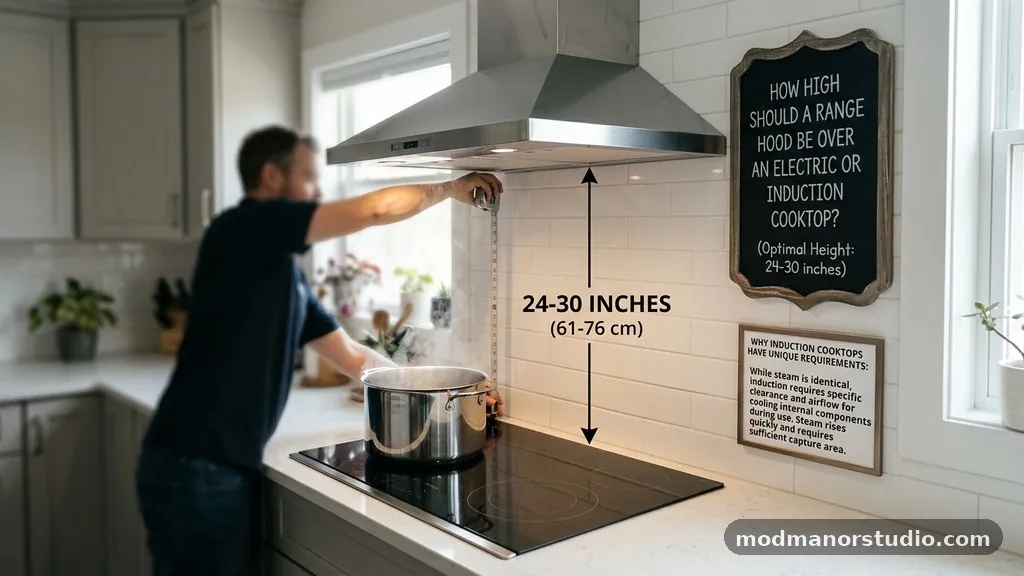
Induction technology works differently than traditional electric coils or glass-ceramic radiant heaters. Because induction uses magnetic fields to heat the cookware directly, there is no open flame and, generally, less ambient heat produced around the sides of the pan.
This unique thermal profile often allows for slightly more flexibility in your installation height compared to gas ranges. You do not need to worry as much about the hood’s finish or electrical components melting due to stray heat.
However, you still need to follow the National Fire Protection Association guidelines regarding general kitchen safety and ventilation distances. Even if the cooktop itself is cooler to the touch, the food being cooked—especially if you are searing or deep-frying—still generates grease-laden steam.
The physics of smoke and steam rising remains the same regardless of the heat source. Therefore, you should never exceed the maximum manufacturer-recommended height, even with an induction unit, because the hood will lose its ability to capture airborne contaminants effectively.
Most induction manufacturers provide a specific “installation envelope” in their manuals. If you ignore these numbers, you might void your warranty.
Some high-end induction units are paired with smart hoods that communicate via Bluetooth, adjusting their speed based on the temperature of the burner. If you have this type of integrated system, the manufacturer will provide very precise instructions on the optimal height to ensure the sensors work correctly.
The Impact of Hood Power and CFM
The height of your hood is directly tied to its power, measured in CFM. A range hood with high CFM ratings can be installed slightly higher because it has the suction force to pull air from a greater distance.
Conversely, a low-power, recirculating hood must be installed lower to be of any real use. If you have a professional-style hood with 600 to 1,200 CFM, you have more leeway in your kitchen design.
Consider the following table to understand how power and height requirements typically correlate for residential kitchens:
| Hood Type | Recommended Height (Inches) | Typical CFM Range |
|---|---|---|
| Under-Cabinet (Entry) | 20–24 | 200–400 |
| Wall-Mounted (Standard) | 24–30 | 400–600 |
| Professional Island Hood | 30–36 | 600–1200+ |
If you are cooking for a large family or frequently use high-heat techniques, you should prioritize a higher CFM rating over a higher mounting position. It is better to have a powerful hood at 26 inches than a weak one at 30 inches.
A powerful motor compensates for the distance by creating a larger “capture zone,” ensuring that even smoke rising from the back burners is pulled into the filters. Always check the manufacturer’s documentation for your specific model to see if they mandate a minimum clearance for high-power units.
Island Hoods and Ventilation Challenges
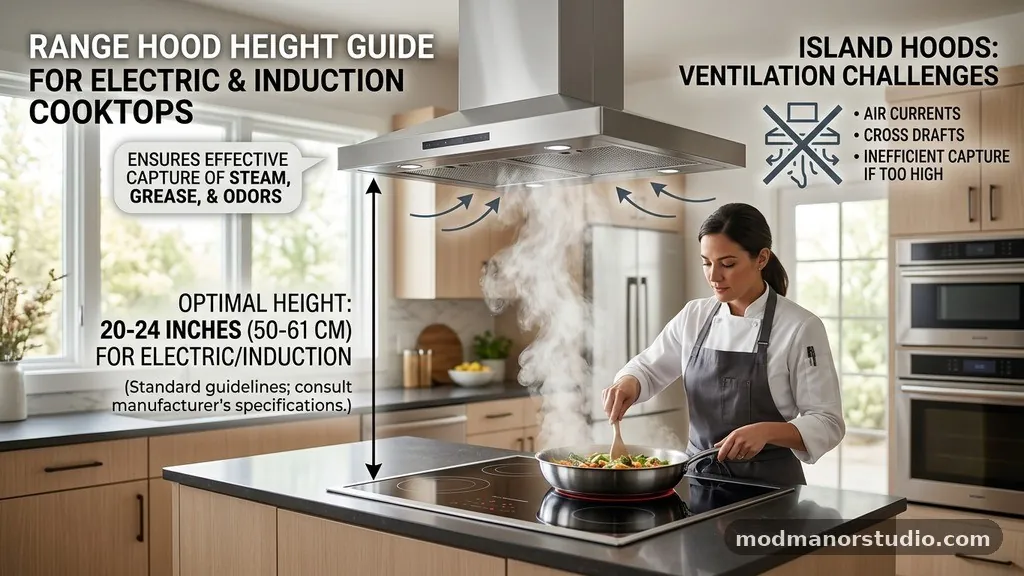
Installing a range hood over an island cooktop presents a unique set of challenges compared to a wall-mounted installation. Because island hoods do not have the benefit of a wall to help “trap” smoke and steam, they are naturally less efficient.
Smoke can easily escape from the sides of an island unit if it is mounted too high or is undersized for the cooktop. This is why many experts recommend an island hood that is at least 6 inches wider than the cooking surface itself.
Regarding height, island hoods are often placed higher than wall hoods to preserve sightlines across the kitchen. A common mistake is mounting an island hood so high that it becomes purely decorative.
If you must mount it at 32 or 34 inches to maintain an open view, you must compensate by ensuring the hood is significantly wider than the cooktop. This extra width creates a larger perimeter to catch the rising grease and steam that would otherwise bypass a smaller unit.
Furthermore, island hoods are susceptible to cross-drafts. Air conditioning vents, ceiling fans, and open windows can push steam away from the hood before it reaches the filters.
If your island cooktop is near a high-traffic area or an HVAC vent, you should aim for the lower end of the recommended height range. Keeping the hood closer to the surface minimizes the window of time that air currents have to disrupt the rising plume of smoke.
Calculating the Proper Clearance for Your Space
To calculate the ideal height for your specific kitchen, start by measuring the distance from your finished floor to the bottom of the range hood. You will need to account for the height of your countertops, which is usually standard at 36 inches.
If you have a custom-built island or non-standard counters, adjust your math accordingly. The goal is to reach the target clearance range established by the cooktop and hood manuals.
Always check the “minimum” and “maximum” thresholds provided by the manufacturer. You might find that your hood requires a minimum of 26 inches, while your cooktop allows for anything up to 30 inches. In this case, you have a 4-inch “zone of flexibility.”
You can choose any height within this range based on your personal height and comfort. If you are tall, the 30-inch mark is likely more comfortable, while shorter cooks might prefer the 26-inch mark for better access to the controls.
Don’t forget to account for the thickness of any decorative trim or backsplash tiles. If your backsplash extends behind the hood, you need to ensure the mounting hardware is secured into studs.
If you are installing a heavy range hood, the mounting height might be dictated by the location of the wall blocking or the structural support in the ceiling. Plan these structural details before you finalize your kitchen cabinet layout.
The Role of Cooking Habits

Your specific cooking style plays a major role in determining how high your range hood should be. If you primarily boil pasta, steam vegetables, or use a slow cooker, you are dealing with low-grease moisture.
In these scenarios, a hood installed at the higher end of the recommended range (30 inches) will perform perfectly fine. You are mostly clearing humidity, which dissipates easily.
However, if your household frequently sears steaks, stir-fries in a wok, or uses high-temperature frying, you are generating significant grease particles. These particles are heavy and need to be captured quickly before they have a chance to cool and settle on your kitchen surfaces.
For high-heat cooking, a lower mounting position is always better. It keeps the grease-laden air in a concentrated stream that the fan can easily pull into the filters.
Think about the types of pots you use as well. If you frequently use tall stockpots for canning or large-batch soups, you need to ensure the bottom of the hood does not interfere with the lid of your tallest pot.
A hood that is too low can actually be a safety hazard if it is close enough to ignite grease buildup from a tall, bubbling pot. Always measure your tallest piece of cookware and ensure there is at least 6 to 8 inches of clearance between that pot and the hood.
Common Installation Pitfalls
Many homeowners focus entirely on the aesthetic impact of the range hood and ignore the functional reality of installation. One common error is failing to account for the depth of the hood.
A hood that is too shallow will not capture smoke from the front burners, no matter how high or low it is mounted. If your cooktop is 24 inches deep, your hood should ideally be at least 22 to 24 inches deep as well.
Another frequent problem is the incorrect use of ductwork. Even if you mount your hood at the perfect height, if the ductwork is restricted, too narrow, or has too many bends, the motor will not be able to move the air.
This causes a “backpressure” effect where the hood sounds loud but does not actually pull air. When planning your installation, ensure the duct diameter matches the hood outlet size exactly.
Finally, do not underestimate the importance of the backsplash. Many people install the hood first and then struggle to fit the tile underneath.
It is usually best to install your backsplash tiles before mounting the range hood to ensure a clean, seamless look. If you are mounting to a tiled surface, ensure you have the proper masonry drill bits to avoid cracking the tile during the installation process.
Safety Considerations and Fire Prevention
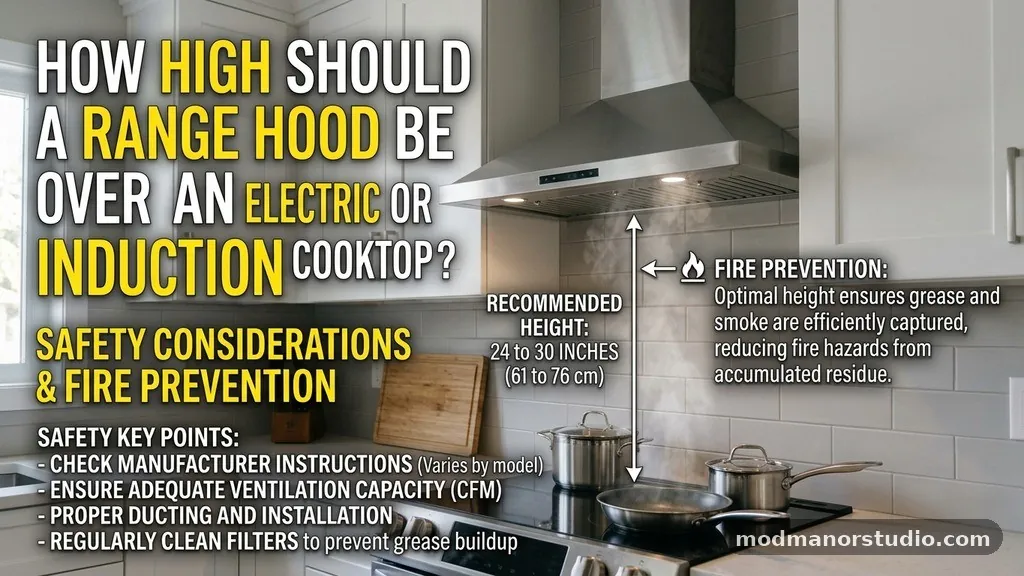
While electric and induction cooktops are safer than gas, the range hood itself remains a potential fuel source if it is not maintained. Grease buildup inside the filters and the motor housing is highly flammable.
Regardless of how high you mount the unit, you must clean your filters regularly. If you cook frequently, try to wash your metal mesh filters every two to four weeks in a dishwasher or with hot, soapy water.
When considering the height, also think about the reach of the person who uses the stove most often. If the hood is mounted too high, you might be tempted to leave it off because the controls are difficult to reach.
Conversely, if it is mounted too low, you might bump your head, which is a common kitchen injury. A good rule of thumb is to stand at the stove and mimic your cooking motions.
If you are concerned about the hood being a fire hazard, look for models that include a thermal sensor. These sensors automatically turn the fan to its highest speed if they detect a sudden, dangerous rise in temperature at the hood level. This is a great safety feature for any kitchen, especially if you have children or elderly family members who might occasionally leave a burner on.
Frequently Asked Questions
Can I install a range hood higher than the manufacturer suggests?
No, you should never exceed the maximum height recommended by the manufacturer. Doing so significantly reduces the hood’s ability to capture smoke and grease, leading to poor air quality and grease buildup on your cabinets. It may also void your product warranty.
Does the type of cooktop matter for hood height?
Yes, it does. While induction and electric cooktops have similar height requirements, gas cooktops often require more clearance due to the open flame and heat output. Always follow the specific requirements listed in the manual for your exact cooktop model.
How do I know if my hood is powerful enough for a higher installation?
Check your hood’s CFM rating. If you want to install it at the higher end of the recommended range (e.g., 30 inches), you generally want a higher CFM rating to ensure the fan has enough “pull” to clear the air effectively. A low-CFM unit should always be installed at the lower end of the allowed height.
What if my ceiling is too high for a standard hood installation?
If your ceiling is very high, you will need a chimney extension kit for your range hood. These kits allow you to bridge the gap between the hood body and the ceiling while maintaining the correct height above the cooking surface. Most major hood manufacturers sell these as optional accessories.
Is it better to have the hood slightly lower or slightly higher?
For performance, lower is almost always better because it captures smoke and grease more efficiently. For aesthetics and physical comfort, higher is often preferred. Aim for the lowest height that still feels comfortable and doesn’t obstruct your workspace or view.
Achieving the Perfect Kitchen Ventilation
Finding the right answer to how high should a range hood be over an electric or induction cooktop is a balance between performance, safety, and personal comfort. By adhering to the 24 to 30-inch range, you ensure that your ventilation system functions as intended, removing harmful particles and moisture before they settle on your home’s surfaces. Remember that the manufacturer’s documentation is your primary guide, as specific models may have unique thermal requirements.
Beyond the numbers, consider your own cooking habits and the layout of your kitchen. A well-planned installation not only keeps your kitchen cleaner but also makes your cooking space more enjoyable to use every day. Take the time to measure your tallest cookware, check your ceiling height, and verify your ducting before you finalize your plans.
With these steps completed, you can confidently install your range hood and enjoy a professional-grade environment for all your culinary projects. If you need further clarification on your specific model, feel free to consult your owner’s manual or reach out to a local professional for guidance on your kitchen setup.