How to Calculate Range Hood CFM Based on Total Gas Cooktop BTUs
Getting the ventilation right in your kitchen is about more than aesthetics; it is about performance and safety. When you are calculating Range Hood CFM Based on Total Gas Cooktop BTUs, you are essentially determining how much air your fan needs to move to keep your kitchen free of smoke, grease, and combustion byproducts.
A common rule of thumb is to divide your total burner output by 100, but real-world factors like duct length and hood width change the equation. By understanding these variables, you can ensure your kitchen range remains a comfortable space while avoiding the common pitfalls of inadequate airflow.
The Basic BTU to CFM Conversion Formula

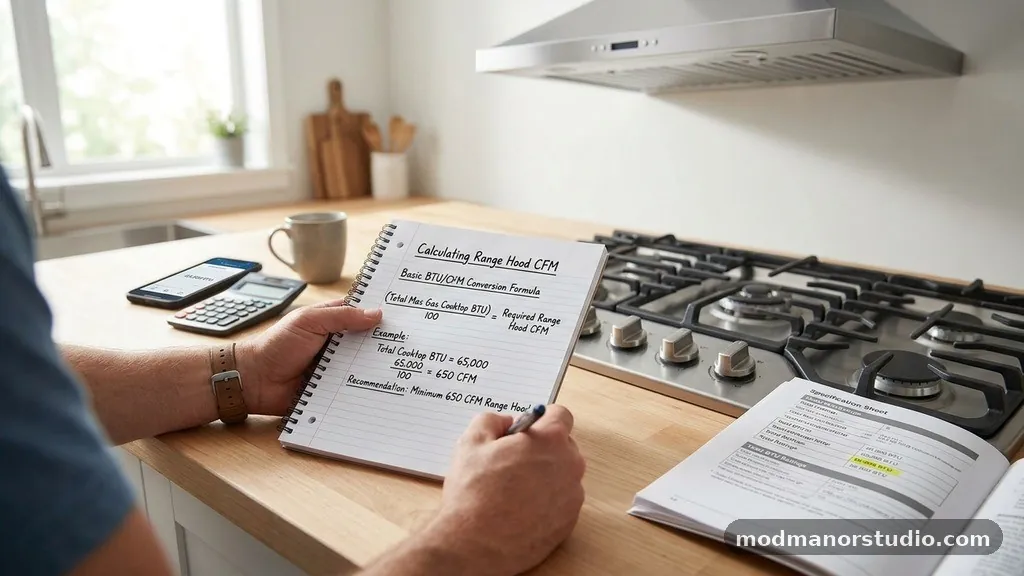
To determine the ventilation power you need, start by identifying the total heat output of your cooking appliance. Most gas cooktops list the BTU (British Thermal Unit) rating for each individual burner.
You should sum these values to find your total BTU rating. Once you have that figure, divide it by 100 to get the baseline CFM (Cubic Feet per Minute) recommendation.
For example, if you have four burners rated at 15,000 BTUs each, your total is 60,000 BTUs. Dividing this by 100 gives you a requirement of 600 CFM.
While this is a helpful starting point, it is rarely the final answer for a high-performance kitchen. Many professional-style ranges exceed this baseline, and your specific cooking habits—like frequent searing or heavy wok use—may necessitate a higher capacity.
Why Total BTU Is Just the Starting Point
While the “divide by 100” rule is a standard industry guideline, it assumes an ideal installation. It does not account for the physical constraints of your home, such as the length and complexity of your ducting.
Every elbow, bend, and transition in your ductwork creates resistance that slows down the actual airflow. A hood rated at 600 CFM might only perform at 450 CFM if the ducting is restricted or improperly sized.
Furthermore, the width of your hood plays a massive role in how effectively it captures smoke. If your hood is the same width as your cooktop, it may miss airborne particles escaping from the outer burners.
Pros often recommend a hood that is at least six inches wider than the cooktop itself. This extra coverage ensures that even the smoke rising from the edge of the stove is pulled into the intake area.
The Critical Role of Ductwork and Static Pressure
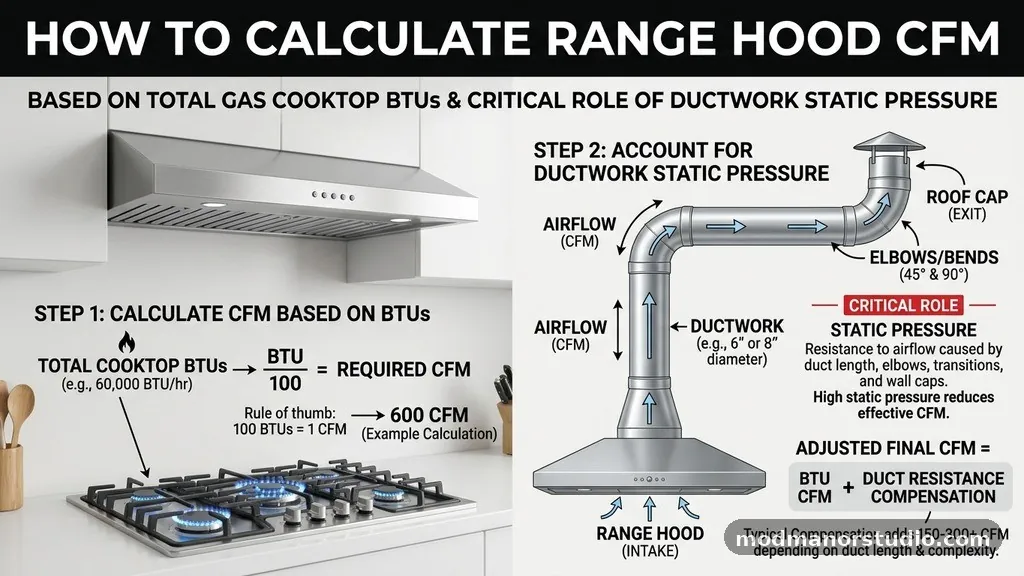
Your range hood’s motor is only as good as the path it has to push air through. Static pressure is the resistance the fan encounters as it forces air through the duct and out of the house.
If you use a narrow duct, such as a 6-inch pipe for a high-CFM hood, you increase backpressure significantly. This causes the motor to work harder, creates excessive noise, and reduces the amount of smoke actually removed from the room.
Always check the manufacturer’s recommendation for duct diameter. Most high-capacity hoods require 8-inch or even 10-inch round ducting to reach their rated performance levels.
If your kitchen layout forces you to use a longer run of ducting or multiple 90-degree turns, consider upgrading to a more powerful motor to compensate for the drag. You can find detailed technical guidance on these requirements through the American Society of Heating, Refrigerating and Air-Conditioning Engineers for best practices in residential ventilation.
Accounting for Makeup Air Systems
When you install a high-CFM hood, you are effectively acting as a giant vacuum cleaner. If your house is tightly sealed, the hood will struggle to pull air out because there is no path for replacement air to enter.
This creates negative pressure, which can pull dangerous combustion gases back into the kitchen from other appliances like water heaters or furnaces. In many regions, building codes now mandate a makeup air system once your hood exceeds a certain threshold, often 400 CFM.
A makeup air system works by bringing fresh, tempered air into the home to replace what the hood exhausts. This balances the pressure, allowing your fan to operate at its peak efficiency without straining the motor.
While this adds to the overall cost of your ventilation project, it is a vital safety feature for any modern home. Ignoring this requirement can lead to poor performance and potential health hazards in your living space.
Impact of Cooking Style on CFM Selection

Your personal cooking style is arguably as important as the BTU rating of your burners. If you primarily boil water for pasta or reheat leftovers, you can likely get away with a lower CFM rating.
However, if you regularly sear steaks, fry foods, or use large pots that generate significant heat and grease, you need a higher capacity. High-heat cooking creates a massive volume of airborne particulates that a standard 300 CFM fan simply cannot manage.
Consider your frequency of use as well. If you cook large meals for a family every night, your ventilation system will see significantly more wear than a system used intermittently.
Investing in a slightly higher CFM capacity than your BTU math suggests provides a “buffer.” This allows you to run the fan on a lower, quieter setting for most tasks while still having the power to clear the kitchen during heavy cooking sessions.
Comparing Hood Types and Performance
Not all hoods are created equal, even if they share the same CFM rating. Wall-mount, island, and under-cabinet hoods all interact with airflow differently.
Island hoods, in particular, are notoriously difficult to vent because they lack the wall surface to help “trap” smoke before it hits the filter. Because cross-drafts in an open kitchen can easily push smoke away from an island hood, you often need to increase your CFM calculation by 20% to 30% to compensate.
The following table illustrates how different kitchen configurations influence the required ventilation power beyond the basic BTU calculation:
| Kitchen Feature | Impact on CFM Needs | Recommended Adjustment |
|---|---|---|
| Island Mount | High cross-draft risk | Add 20-30% to base CFM |
| Long Duct Run | High static pressure | Increase duct diameter |
| Heavy Searing | High particulate volume | Add 150-200 CFM |
| Wall-Mounted | Better smoke capture | Baseline math is sufficient |
The Importance of Hood Depth and Coverage

Many homeowners focus entirely on the width of the hood while ignoring the depth. A range hood should ideally cover the front burners, but many shallow designs only cover the back half of the cooktop.
If the hood does not extend over the front burners, the rising smoke and grease will bypass the intake entirely. When calculating your needs, ensure the hood depth is sufficient to capture the plume from your largest pots.
If you are limited by cabinet space and cannot install a deep hood, you must compensate with higher airflow. A more powerful motor can sometimes “pull” smoke from a slightly greater distance, though it is never as effective as physical coverage.
Always prioritize a hood that provides at least 20 to 22 inches of depth for a standard gas range. This ensures that the capture area is positioned directly over the primary heat sources.
Noise Levels and Motor Placement
A common complaint with high-CFM hoods is the noise generated by the fan. As you increase the CFM, the sound level—measured in sones—usually increases as well.
If you are aiming for a high-performance setup, consider an external blower or an inline blower. These units place the noisy motor outside the house or in the attic, rather than directly over your head.
Internal blowers are the most common and easiest to install, but they are inherently louder. If you find that you need high CFM but want a quiet kitchen, look for hoods that offer multiple speed settings.
Being able to run the fan at 300 CFM for light cooking and 900 CFM for heavy searing gives you the best of both worlds. Remember that a larger, quieter fan running at lower speeds is often more effective than a small, high-pitched fan running at full blast.
Maintenance and Filter Efficiency

The calculation for your hood is only valid if the system is clean. Grease buildup on your filters acts as a significant restriction to airflow, effectively lowering your CFM mid-cook.
If you have a high-BTU cooktop, you will generate more grease, which necessitates more frequent cleaning of your baffle filters. Stainless steel baffle filters are generally superior to mesh filters because they don’t clog as quickly and are easier to put through the dishwasher.
When the filters are clogged, the motor experiences higher strain, which can lead to premature failure. You should inspect your filters at least once a month.
If you notice smoke lingering in the kitchen even while the fan is on high, it is a clear sign that your filters need a deep clean or that your ducting has become restricted. Regular maintenance ensures that the CFM you calculated at the start of your project remains the CFM you actually get during daily use.
Common Mistakes to Avoid
One of the biggest errors is choosing a hood based solely on the “CFM number” printed on the box. Many manufacturers use misleading marketing that ignores the effect of static pressure.
Another common mistake is using flexible ducting instead of smooth-walled rigid metal. Flexible ducting is ribbed on the inside, which causes immense turbulence and drastically reduces the performance of your ventilation system.
Avoid reducing the duct size at any point in the run. If your hood has an 8-inch outlet, you must use 8-inch ducting all the way to the exterior wall cap.
Reducing the diameter to 6 inches at the wall cap will choke the fan and force it to work against its own air pressure. Always consult the installation manual for your specific model to understand the exact ducting requirements before you finalize your purchase.
Frequently Asked Questions
Is a 300 CFM range hood sufficient for my gas cooktop?
A 300 CFM hood is typically only sufficient for very small gas cooktops with low BTU output. If you have a standard 30-inch range with four burners, you will likely find that 300 CFM is inadequate for anything beyond light simmering. Most experts recommend at least 400 to 600 CFM for a standard residential gas range to ensure proper smoke and moisture removal.
How do I calculate CFM from BTU correctly?
The most common method is the “divide by 100” rule, where you take the total BTU rating of all burners and divide by 100 to get a baseline CFM. For a 50,000 BTU range, this gives you 500 CFM. However, you must also consider the layout of your kitchen, the length of your ductwork, and your specific cooking habits to determine if you need to size up.
Do I need a makeup air system for my kitchen?
Many local building codes require a makeup air system if your range hood exceeds 400 CFM. This system prevents negative pressure in your home, which can cause back-drafting of combustion gases from other appliances. It is a critical safety consideration for any high-performance ventilation install and should be verified with your local building department.
What is the best type of filter for a gas range?
Stainless steel baffle filters are the industry standard for gas ranges. They are designed to capture grease by forcing the air to change direction, while the heavy metal construction is durable enough for high-heat environments. Unlike mesh filters, they do not restrict airflow as they get dirty, ensuring your hood maintains its rated performance for longer periods.
Why does my hood sound so loud?
Noise is usually a result of high static pressure or an undersized motor working too hard. If your ductwork has too many turns, or if the duct diameter is too small, the fan will struggle and become noisy. Using an inline or external blower can help move the motor noise away from the kitchen, resulting in a much quieter cooking experience.
Conclusion
Calculating the right ventilation power is a blend of basic math and practical home design. By starting with the total BTU output of your cooktop and adjusting for duct constraints, hood width, and cooking habits, you can land on a CFM value that keeps your kitchen comfortable and safe. Remember that the best hood in the world will struggle if it is connected to improper ducting or if the kitchen lacks adequate makeup air.
Take the time to plan your duct path carefully, as smooth airflow is just as important as the motor’s rated power. If you are unsure about your specific needs, consult a professional installer who can measure your kitchen’s static pressure. A well-ventilated home is one of the most important aspects of a functional kitchen, allowing you to focus on your cooking rather than the smoke in the air.